Every year-end, the same scene plays out: a spreadsheet shared in a hurry, employees chased by email, equipment nowhere to be found and gaps nobody can explain. Yet an annual equipment inventory in your company is simple common sense for any organisation that invests in computers, phones, tools or protective equipment.
It serves accounting, of course, but also security, renewals and next year's budget. When it is poorly prepared, it takes up whole days for an approximate result.
The good news: it does not have to be a chore. Here is why the exercise is so painful, followed by four practical methods to make it easier, from the simplest to the most structured.
Why company inventories often turn into a headache
The problem rarely comes from the counting itself. It comes from what happened over the previous twelve months:
- equipment changed hands without anyone recording it;
- information is scattered across several files, inboxes and notebooks;
- employees joining and leaving did not always lead to a formal handover or return;
- nobody is clearly responsible for keeping the list up to date.
As a result, the inventory becomes an investigation rather than a simple check. The bigger the gap between the theoretical list and reality, the longer it takes.
Preparing your company's equipment inventory: the basics
Whichever method you choose, a few prerequisites will save you valuable time:
- Define the scope: which types of equipment, which sites, which departments?
- Appoint a coordinator: one person runs the operation and collects all feedback.
- Set a reference date: the state of your equipment is recorded at a specific point in time, to avoid duplicates and omissions.
- Choose what to record: type, serial number, user, location, condition.
Method 1: a well-structured shared Excel spreadsheet
This is where most organisations start, and it can be enough for a small fleet. Provided it is properly structured:
- a single reference file, with the same columns for everyone;
- drop-down lists to limit free-text entries;
- one person responsible for changes.
Its limit: it relies entirely on everyone's discipline. As your fleet grows, versions multiply and so do discrepancies.
Method 2: self-declaration by employees
Rather than listing everything yourself, you ask each employee to confirm the equipment they hold: a short form or an email with a pre-filled list, to approve or correct.
The upside: the workload is shared and discrepancies surface quickly.
Watch out: you need to chase late responders and plan spot checks to make sure the answers are reliable.
Method 3: physical counting by zone
This method involves walking through your premises, office by office or room by room, and comparing what you see with the theoretical list. It is the most reliable way to spot undeclared equipment, but also the most time-consuming.
- Divide your premises into zones and share them out between several people.
- Always record the serial number or label of each item.
- Note any equipment found but missing from the list, and vice versa.
For an IT asset inventory, this method has a limit: some devices are never in the office. Laptops, phones and screens used for remote work escape zone counting. Combine it with self-declaration to cover this mobile equipment.
This approach is useful from time to time, for example to establish a reliable starting point, but it becomes heavy if it has to be repeated in full every year.
Method 4: continuous inventory, all year round
This is the method that removes the chore at its source. Instead of rebuilding your fleet once a year, you keep it up to date as you go: every assignment, return or change of location is recorded when it happens.
- Each item has a single record with its key information.
- Every movement is logged in an assignment history for each employee.
- QR code labels let you identify any item in seconds, with just a smartphone.
The annual inventory then becomes a check rather than a reconstruction. It takes a little organisation at the start, but it is the most lasting time saver.
Which inventory method is right for your company?
There is no one-size-fits-all answer, but a few pointers help:
- small fleet, few movements: a well-structured spreadsheet, backed up by self-declaration;
- uncertain starting point: a one-off physical count to get back on solid ground;
- large fleet, several sites or frequent movements: a continuous inventory, powered by equipment management software, so you never start from scratch again.
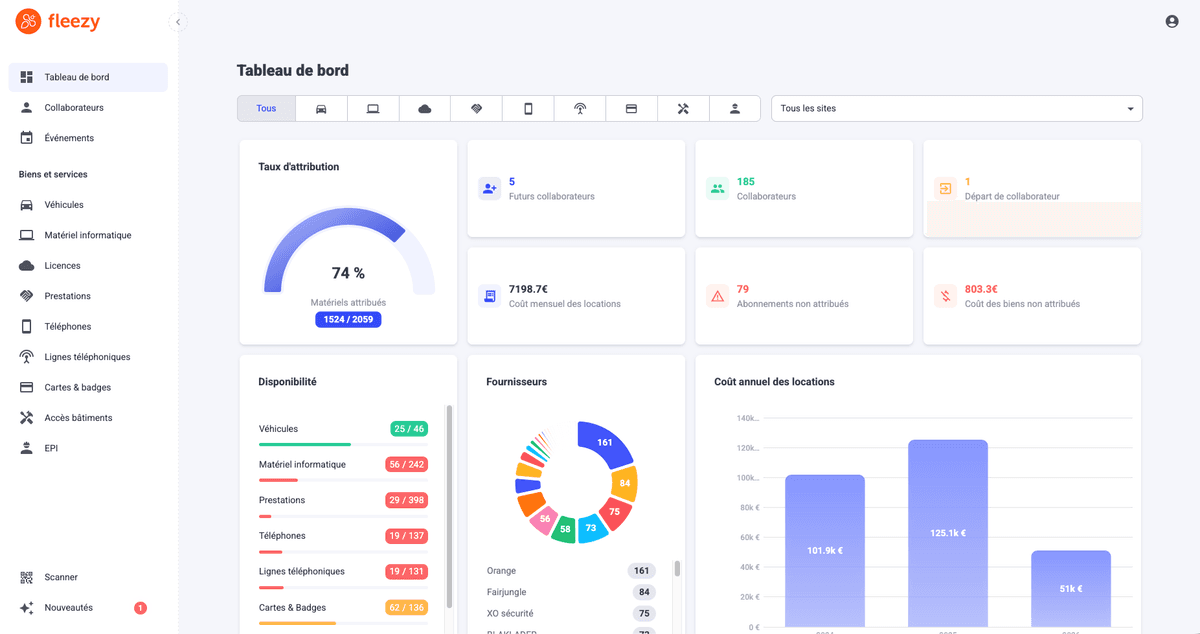
In practice, these methods work well together, and they all lead to the same goal: no longer having to rebuild your fleet every year. That is where a tool like Fleezy makes the difference: once each item is labelled and assigned, movements are recorded as they happen, and the annual inventory comes down to a quick check.
Conclusion: turning a chore into a simple check
A painful annual inventory is the symptom of poor tracking the rest of the year. By defining the scope, involving employees and, above all, recording movements as they happen, you reduce the exercise to a quick check.
That is the thinking behind Fleezy: centralise your equipment, keep one record per item, retain the assignment history for each employee and identify every item with a QR code. All of which helps you approach the end of the year with peace of mind.
Centralise your equipment, with one record per item.
Track every assignment and turn your annual inventory into a simple check.
Company equipment inventory FAQ
Good inventory software should let you create a record for each item, track who it is assigned to, keep a history of movements and identify equipment by QR code. Be careful: much inventory software is designed for stock and goods. For equipment your teams use every day, equipment management software like Fleezy is a better fit.
List the categories to cover (computers, screens, phones, accessories), label each item, link it to a user, then ask everyone to confirm the equipment they hold. IT inventory software that scans your network detects connected devices, but not who has them in hand or where they are: the two approaches complement each other.
For a small, stable fleet, yes, as long as it is structured: a single file, shared columns, one person in charge. Once equipment moves between several people or sites, versions multiply and the spreadsheet becomes a source of discrepancies.
At least once a year, when closing the accounts. But the more your fleet is tracked as you go, the faster this annual inventory becomes: with continuous tracking, it comes down to a check of a few hours.