A laptop that never comes back after someone leaves, a misplaced badge, a phone forgotten in a taxi: lost or unreturned equipment is a classic of working life. And every time, the same question comes up, often in a hurry: who is responsible?
The answer is never purely legal. It depends on what was handed over, under what conditions, with what instructions and above all with what proof. Without a clear record of the assignment, it becomes very hard to settle, and discussions between HR, management and IT quickly turn into misunderstandings.
This article covers the main principles of responsibility, the most common situations, and the best practices to avoid getting there. It does not replace legal advice: in case of dispute, contact your legal department or an adviser.
Who is responsible for equipment entrusted to an employee?
As a general rule, the equipment belongs to the company and remains its responsibility. The employee uses it for their work: they must take good care of it and return it at the end of their contract or when the employer asks.
In case of loss or damage, the employee is not automatically liable. It depends on the circumstances: theft, an accident or normal wear and tear are not treated the same way as gross negligence or a deliberate act. Labour law (in France, the Labour Code) also sets a strict framework before any deduction from wages: an employer cannot decide on their own to recover the cost of missing equipment. So it is best not to improvise and to consult a lawyer before taking any action.
The three most common situations
Equipment lost or stolen while in use
In this case, reacting quickly matters more than finding someone to blame. The first steps are simple:
- have the loss or theft reported as soon as possible, in writing, with the circumstances;
- lock or deactivate access (session, email, badge) to limit the risks;
- report the theft to the police if the equipment or data justify it;
- update the item's status so it no longer shows as available.
Equipment not returned after an employee leaves
This is the trickiest situation, because it often plays out after the employment relationship has ended. The employee has left, the item cannot be found, and nobody knows exactly what was handed over to them. The sensible approach is to:
- find the exact list of equipment assigned, with the handover dates;
- send a written, courteous return request, listing the items concerned;
- follow up if necessary, then involve your legal department if the equipment is still not returned.
Equipment lent between colleagues or departments
A tool lent "for two minutes" to a colleague, a projector taken by another team: these informal loans are the main source of "ghost" equipment. When the item is no longer there, everyone assumes it is somewhere else. Only a clearly recorded assignment shows who had it last.
Why disputes stem from a lack of traceability
In most cases, the disagreement is not about the principle, but about the facts. Nobody can establish what was handed over, to whom, and when. The causes are almost always the same:
- no proof that the equipment was handed over (no signature, no confirmation email);
- items passing from hand to hand without the tracking file being updated;
- information scattered across spreadsheets, inboxes and people's memories;
- items that cannot be identified for lack of a serial number or label.
Best practices to limit equipment losses
Prevention always costs less than looking for someone responsible after the fact. These are the habits that make a difference:
- Hand over equipment against a signature: a dated summary, signed or confirmed by email, listing exactly what is entrusted.
- Identify each item: serial number, internal reference, label or QR code stuck on the item.
- Keep an assignment history: who had what, from when, until when.
- Set up a departure procedure: a return checklist triggered as soon as a departure is announced, not the day before the last day.
- Write an equipment use policy: it sets out the rules on care, reporting losses and returns.
- Check regularly: a periodic review of your equipment avoids discovering discrepancies during the annual inventory.
What to do when equipment is already missing
If the item is already nowhere to be found, proceed step by step rather than in a rush:
- check the assignment history to identify the last known holder;
- contact the person concerned and their manager, without assuming they are responsible;
- document all exchanges and steps taken;
- consult your legal or HR department before any financial or disciplinary measure;
- update the item's status (lost, stolen, removed from the fleet) and learn the lessons for your procedure.
Conclusion: responsibility starts with proof
Knowing who is responsible for lost or unreturned equipment first means knowing who had it, since when and in what condition. The clearer the traceability, the fewer the conflicts, and the more calmly they are resolved.
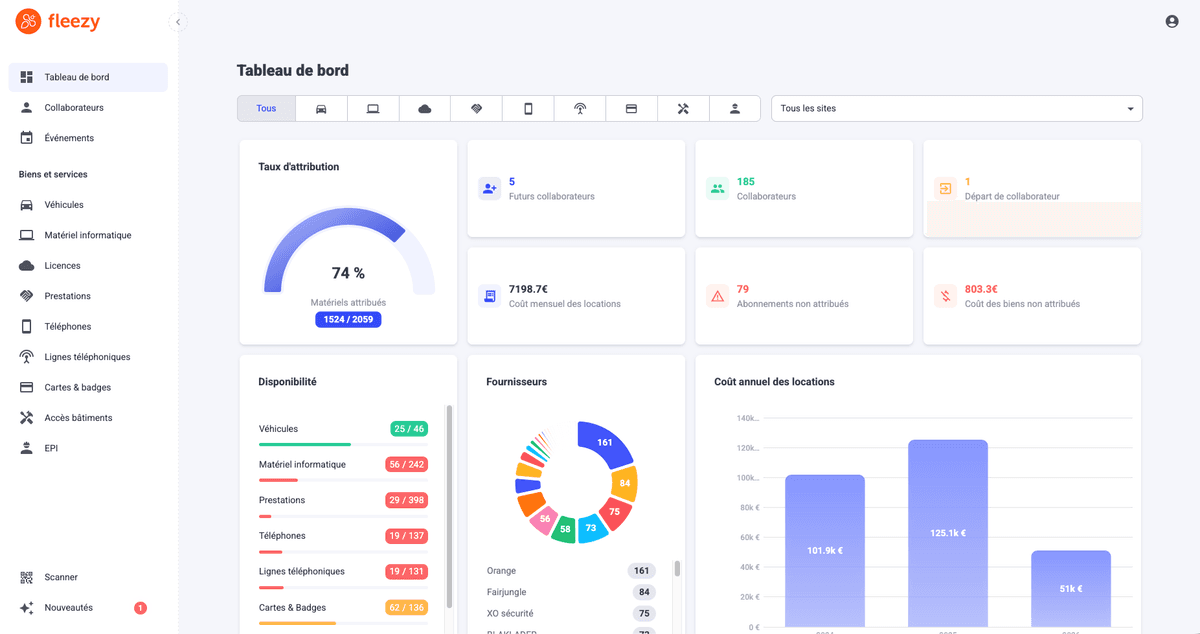
That is the thinking behind Fleezy: it centralises your equipment fleet, provides one record per item, keeps the assignment history for each employee and lets you identify every item with a QR code. So you can find out in seconds who held what, without digging through your spreadsheets.
✓ Find the equipment assigned to each employee in seconds.
✓ Keep the history of every assignment, from handover to return.
FAQ: lost or unreturned company equipment
In principle, the company, which remains the owner of the equipment. An employee can only be held financially liable in exceptional and strictly regulated situations, and an employer cannot decide on their own to deduct the cost from wages. Consult a lawyer before taking any action. In all cases, the best protection is proof of handover and an up-to-date assignment history.
First, find the exact list of equipment assigned to them, with the handover dates. Then send them a written, courteous return request, listing the items and setting a deadline. Follow up if necessary, then involve your legal department. To avoid getting there, trigger the return process as soon as the departure is announced, not on the last day.
It is strongly recommended. The form records what was handed over, on what date and in what condition. It clarifies the employee's responsibility and serves as a reference when the equipment is returned. In case of disagreement, it is often the only document that settles the matter.