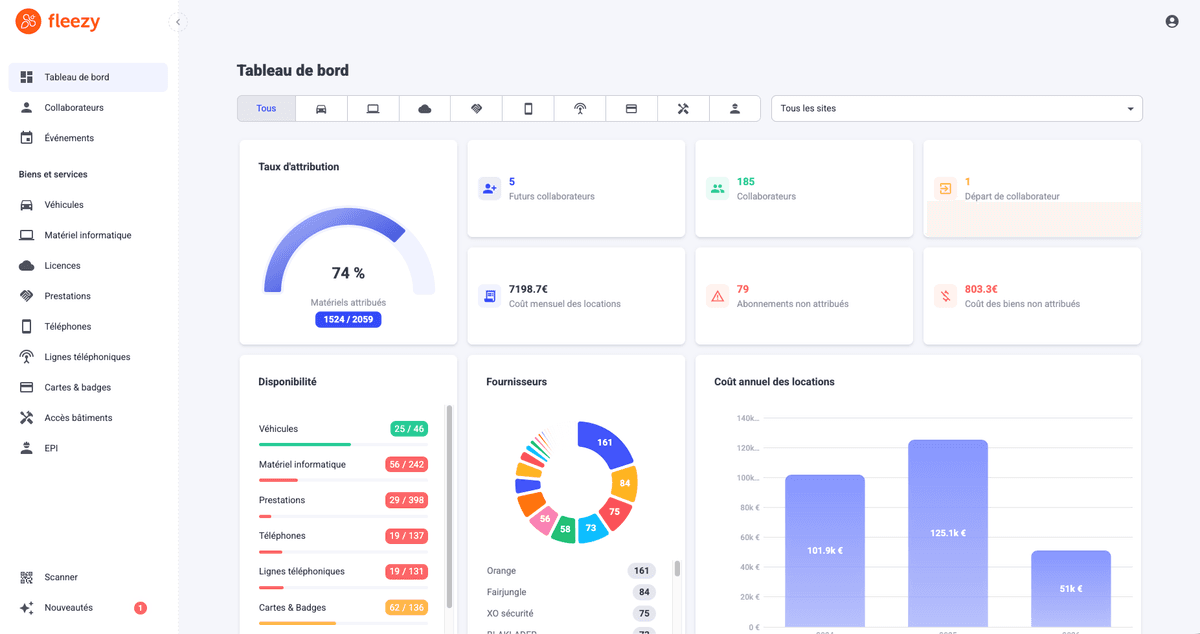
As part of its operations, a company enters into numerous contracts with various internal and external stakeholders. Managing and tracking them properly is important for the smooth running of the business, in order to avoid financial losses or legal issues. So how can you effectively and safely master the management of your company's contracts? That's what we'll explore in the article below.
Contract management: what does it involve?
What is a contract?
According to Article 1101 of the French Civil Code, a contract is defined as "an agreement that creates obligations, requiring a meeting of wills between at least two people." It is therefore a commitment between two parties, each made up of one or more people.
In the context of a business, the contract is the foundation of the relationship with its suppliers, customers, partners, and even its employees. It can therefore take several forms: employment contracts, lease agreements, or sales contracts. A distinction is also made between private contracts (concluded between two private parties) and administrative contracts (concluded by a public administration).
The purpose of this document is to set out the terms and legal framework needed for its proper execution. Each party is assigned specific obligations.
Who manages contracts within a company?
The contract manager is the main person responsible for this task. They oversee the entire process for all of the organization's contracts.
However, other stakeholders may also be involved: legal experts or lawyers, the finance department, the purchasing department, general services, or the managers of various projects. Each of them brings their own expertise and business knowledge. Contract tracking can then fit into a broader mission, namely managing the company's equipment fleet.
Why is good contract management important?
Effective contract management is essential to the smooth running of a business. Without precise tracking, an organization's profitability and reputation can be affected. So what exactly are the stakes when it comes to contract management?
Cost control
A company's contracts require precise cost management. This includes anticipating deadlines (such as automatic renewals), optimizing resource allocation, and verifying that each stakeholder is meeting its financial commitments. Without this, the company risks financial losses or costly disputes.
Process optimization
Well-organized contract management helps improve company performance, such as reducing negotiation timelines or streamlining processes.
Reduced legal risk
This involves carefully analyzing the terms and conditions of each contract to avoid errors or misunderstandings that could lead to disputes. According to a study conducted by Hyperlex and Day One, 50% of companies cite deadline tracking as the main risk in contract management.
How to effectively manage and track your contracts ?
Implementing standardized contract management processes
Contract management requires rigor and foresight. This means putting processes in place within the company so that all relevant employees can follow the same steps. This brings consistency and efficiency to contract tracking. Following well-defined procedures also minimizes errors and omissions that could lead to disputes or non-compliance.
Assigning and distributing responsibilities
For each contract, assigning and distributing responsibilities is essential to ensure effective, compliant execution of contractual commitments. The idea is to designate specific people responsible for each contract and define everyone's role in tracking and managing it. This helps improve efficiency by allowing for better organization and deadline management.
Communicating regularly
Communication and information sharing are essential when it comes to overseeing contracts within a company. A steady flow of information keeps all stakeholders informed in real time. This can take the form of periodic meetings or dedicated communication channels that allow everyone to resolve issues quickly.
Simplify contract management with dedicated software
Choosing a tool to manage your company's contracts depends on your specific needs, size, structure, and the features you're looking for. Tracking contracts using Excel spreadsheets is the most commonly used method. However, it has limitations that can lead to costly errors and a loss of efficiency. That's why investing in dedicated software can simplify contract management, and allow you to manage your assets and services more broadly across many levels.
💡 Tip: how to choose your management software
Before making a decision, it's crucial to assess your specific needs, taking into account ease of use, scalability, integration with other systems, and of course, cost. It can also be helpful to request demos or free trials to test how user-friendly the tool is in a real-world setting.
Centralizing your company's contract data
Software offers far more advanced centralization of information than spreadsheets. All contract data is stored in a structured way and accessible in just one click. No more Excel files scattered across different computers, making it easier to collaborate and quickly consult all contracts.
Automating recurring tasks
Unlike Excel, software automates many repetitive and sometimes costly tasks. In particular, it lets you set up alerts to remind you of important deadlines, reducing the risk of human error.
💡 Tip: automatic renewal, a deadline to watch out for
A contract with an automatic renewal clause is one that renews itself automatically upon expiration. The contract then continues for the same duration and under the same conditions as when it was originally signed. Either party can object to this renewal. However, many companies fail to track this type of deadline as part of their contract management. This can lead to unwanted costs, or the continuation of outdated terms that no longer match the parties' evolving needs. To avoid these pitfalls, tracking this type of deadline can be automated using dedicated software.
Security and access control in contract management
Advanced security features allow you to control access to sensitive information. Permissions can be set based on each user's role and responsibilities, strengthening the confidentiality of contractual data.
In conclusion, contract management is a complex task that companies often neglect. Yet effective organization and regular foresight can prove beneficial both financially and legally. It's therefore important to master it! To simplify your contract management, it's advisable to equip yourself with management software that offers a centralized, automated, and secure solution.