Hard hats, gloves, safety shoes, harnesses, hearing protection… Personal protective equipment (PPE) is part of everyday work in many industries. Yet PPE management is often patchy: a spreadsheet updated now and then, paper handover forms filed in a binder, and expiry dates nobody really keeps an eye on.
The problem is that with PPE, "roughly right" is expensive. Expired, ill-fitting or never-issued equipment means a less protected employee. And if an accident happens, it is up to the employer to prove they met their obligations.
This guide covers what regulations expect from employers, and the practical methods that make sure no piece of PPE slips through the cracks.
Why PPE tracking is an employer liability issue
Handing out PPE is not enough. Employers have a duty of care towards their staff: they must ensure equipment is suited to the risks, in good condition, actually worn and replaced on time.
Without structured tracking, simple questions become hard to answer. Who received which item, and when? Which harnesses are due for inspection this quarter? Which helmets are reaching the end of their service life? During a labour inspection or after an incident, these answers need to be available quickly, with documents to back them up.
PPE regulations: what employers are required to do
In the EU, the design and placing on the market of PPE are governed by Regulation (EU) 2016/425, while the rules on its use at work are set by national law (in France, the Labour Code). On the employer side, obligations fall into four main areas.
Choose PPE suited to the risks
PPE selection follows from the occupational risk assessment. Equipment must fit the job and the wearer, and comply with regulations (including CE marking). It is provided free of charge to employees and is, as a rule, for personal use.
Keep equipment in good condition
Employers must maintain, repair and replace PPE so it keeps its level of protection. That means knowing the service life stated by the manufacturer, and replacing any damaged or expired item.
Inform and train employees
Every employee must know which risks their PPE protects against, how to wear it and when to use it. For PPE protecting against serious or fatal risks, such as fall-arrest harnesses or respiratory protective equipment, proper training is mandatory, with hands-on practice repeated as often as needed.
Make sure PPE is actually worn
Handing out PPE is not enough: employers must also make sure it is actually worn. Rules on wearing PPE should be written into internal policies and regularly reminded on site. Employees, for their part, must take care of their own safety: repeated refusal to wear PPE can lead to disciplinary action.
Have certain PPE inspected periodically
Some equipment, including fall-arrest systems and respiratory protective devices, requires periodic inspections. Results are recorded in a safety register that must be available for inspection.
If you are unsure about a specific requirement, check the guidance from your national occupational health and safety body.
The most common blind spots in PPE management
In practice, the big obligations are rarely the issue. Day-to-day tracking is. These are the situations that come up most often.
- Forgotten expiry dates: helmets, harnesses and filter cartridges have a limited service life that is rarely tracked reliably.
- Untracked handovers: without a signed handover form, you cannot prove an employee actually received their equipment.
- Poorly managed arrivals and departures: a new hire waits days for their PPE, a leaver returns nothing.
- Overdue periodic inspections: the next inspection date is written down nowhere, or in a file nobody opens.
- Guesswork on sizes and stock: orders are placed in a rush because nobody knows what is left in storage.
4 methods for reliable PPE tracking
1. Centralise your inventory by item and by employee
The first step is to have a single source of truth: each piece of PPE, its type, size, date put into service, end-of-life date and who it is assigned to. As long as this information is scattered across files and departments, tracking stays fragile.
2. Record every handover and every return
Every PPE handover should leave a dated record, ideally signed by the employee. Same logic when someone leaves or changes roles: the return is logged, then the item is reassigned or disposed of. This assignment history is your best evidence during an inspection.
3. Anticipate deadlines instead of chasing them
End of service life, periodic inspection, training renewal: every deadline should be known in advance. The goal is to move from a reactive approach ("this harness should have been inspected last month") to a planned one, with a clear view of upcoming deadlines.
4. Label each item with a QR code
A QR code on individually tracked PPE, such as harnesses, gas detectors or breathing apparatus, gives access to its record in one scan: history, last inspection, next check. In the field, it is the simplest way to keep information up to date without re-entering data.
Fleezy: PPE tracking without spreadsheets
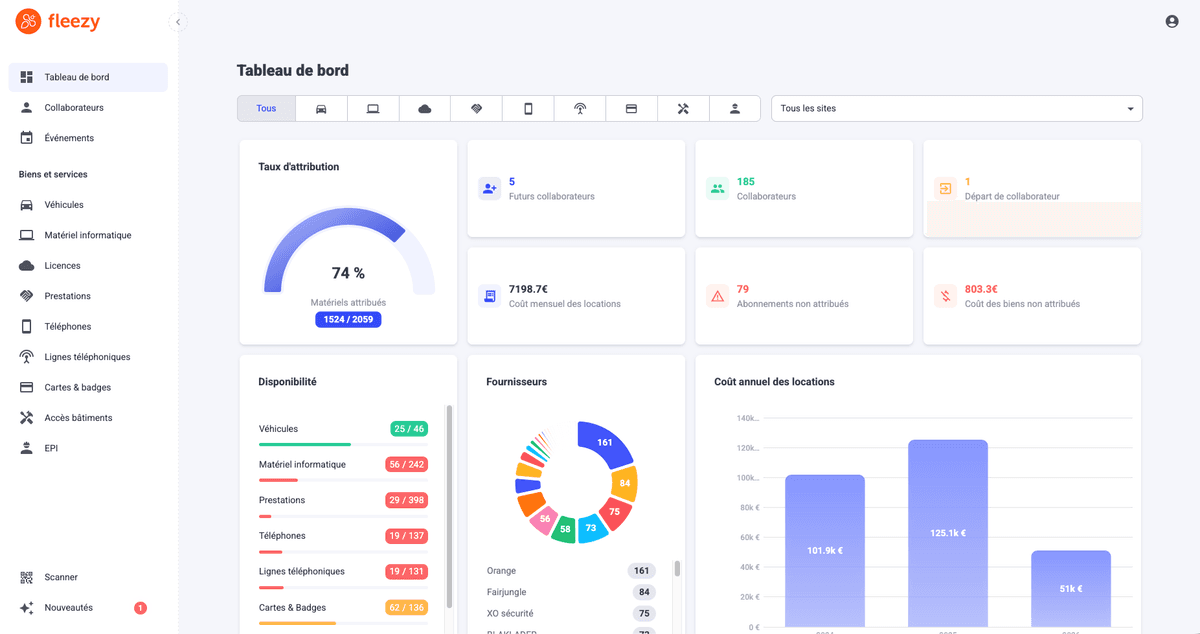
Fleezy brings your entire equipment fleet, PPE included, into a single platform. Each item has its own record and assignment history by employee, and can be identified with a QR code. You always know who holds what and since when, and you have what you need to justify your tracking during an inspection.
Want to see how it would work for your teams? Book a Fleezy demo.
Know at all times who holds which item, PPE included.
Record every handover and return, and be ready on inspection day.
PPE tracking FAQ
For a small number of items, yes. Once PPE runs into dozens of items, several sites are involved or periodic inspections come into play, PPE management software becomes much safer.
It is a tool that centralises your PPE inventory, assignments by employee and the history of handovers and returns. Some solutions cover PPE only; others, like Fleezy, manage the entire equipment fleet, PPE included. One tool for laptops, tools and protective equipment means fewer files to maintain and a complete view of what each employee holds.
There is no single list: mandatory PPE depends on the risks identified in the occupational risk assessment for each job. Employers must provide it whenever risks cannot be avoided or sufficiently limited by collective protective measures.
There is no single document called a "PPE register". In practice, several documents together prove your tracking: the safety register recording periodic inspection results, dated and signed handover forms, manufacturer instructions, the occupational risk assessment and training certificates for PPE protecting against serious or fatal risks. What matters is being able to find them quickly on inspection day.